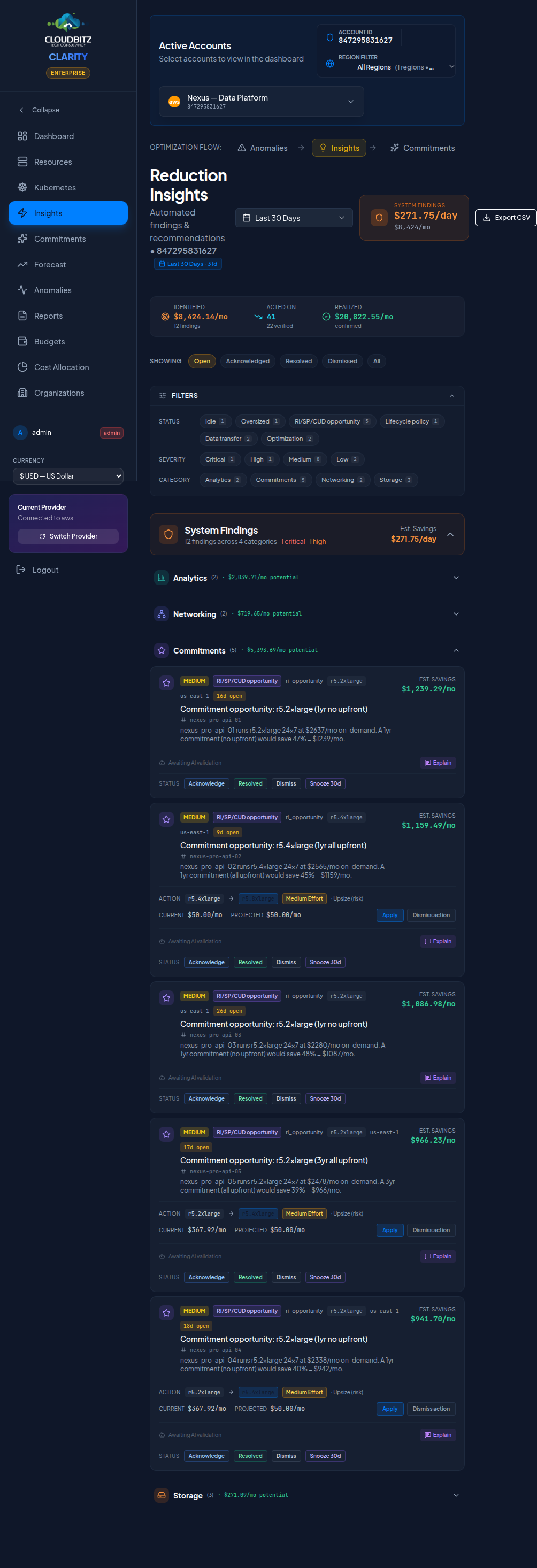
Most FinOps tools hand your team a list of findings and leave the work of agreeing on rules, prioritizing, and actually executing changes to whoever has the time — which is usually nobody. FinOps-as-a-Service closes that gap.
Someone reviews CLARITY's findings with your team every cycle — not a tool you're left to interpret alone.
Right-sizing, commitment purchases, and tag remediation get applied by us, with your sign-off — not left in a backlog.
Idle thresholds, tagging policy, and chargeback rules get defined together — not imposed by a generic default.
Most engagements start with a one-time cloud cost audit — a concrete report, not a sales pitch. If it's a fit, the audit converts into an ongoing retainer: a dedicated engineer keeps watching your accounts in CLARITY, re-validates findings as your infrastructure changes, and executes the next round of fixes — continuously, not as a one-off project.
Everything CLARITY detects, reviewed and acted on by a person who knows your environment
Idle, underutilized, and misconfigured resources surfaced by CLARITY, reviewed by your engineer on a regular cadence — not left for you to triage.
Your engineer re-checks CLARITY's confirmed findings against what actually changed since the last cycle, before anything is acted on.
Approved right-sizing, commitment purchases, and cleanup actions get applied by us — with your sign-off on anything that touches production.
Every executed action is tied to a specific CLARITY finding, so the savings it produces can be measured against what you would have paid otherwise — not estimated after the fact.
Tagging policy, chargeback rules, and idle thresholds set with your team — not a generic default CLARITY ships with.
CLARITY's chargeback engine and cost-center structure get configured to match how your organization actually allocates spend.
A one-time cloud cost audit first — a concrete report of what's idle, misallocated, or missing commitment coverage, no ongoing commitment required.
If the audit shows enough to act on, it converts into the ongoing retainer — the audit's cost applies toward the first month.